
What Is Sound Healing?
Sound healing is a holistic practice that uses sound vibrations to support physical, emotional, and mental well-being. By harnessing specific frequencies and rhythms, sound healing aims to reduce stress, promote relaxation, balance energy, and facilitate healing on multiple levels.
In blending ancient wisdom with modern therapeutic insights, I believe that sound healing is a transformative way to engage the mind, body, and spirit in healing while also encouraging somatic therapeutic rest.
I use pure quartz crystal singing bowls tuned to 440 Hz. Quartz crystal is used because of its stability and vibrational precision to interact with the body’s energy field in subtle ways. The crystal singing bowls are tuned to specific notes that correspond to the seven chakras (e.g., C for root chakra, G for throat chakra), which help with relaxation and promote the release of stagnant emotions.

How It Works
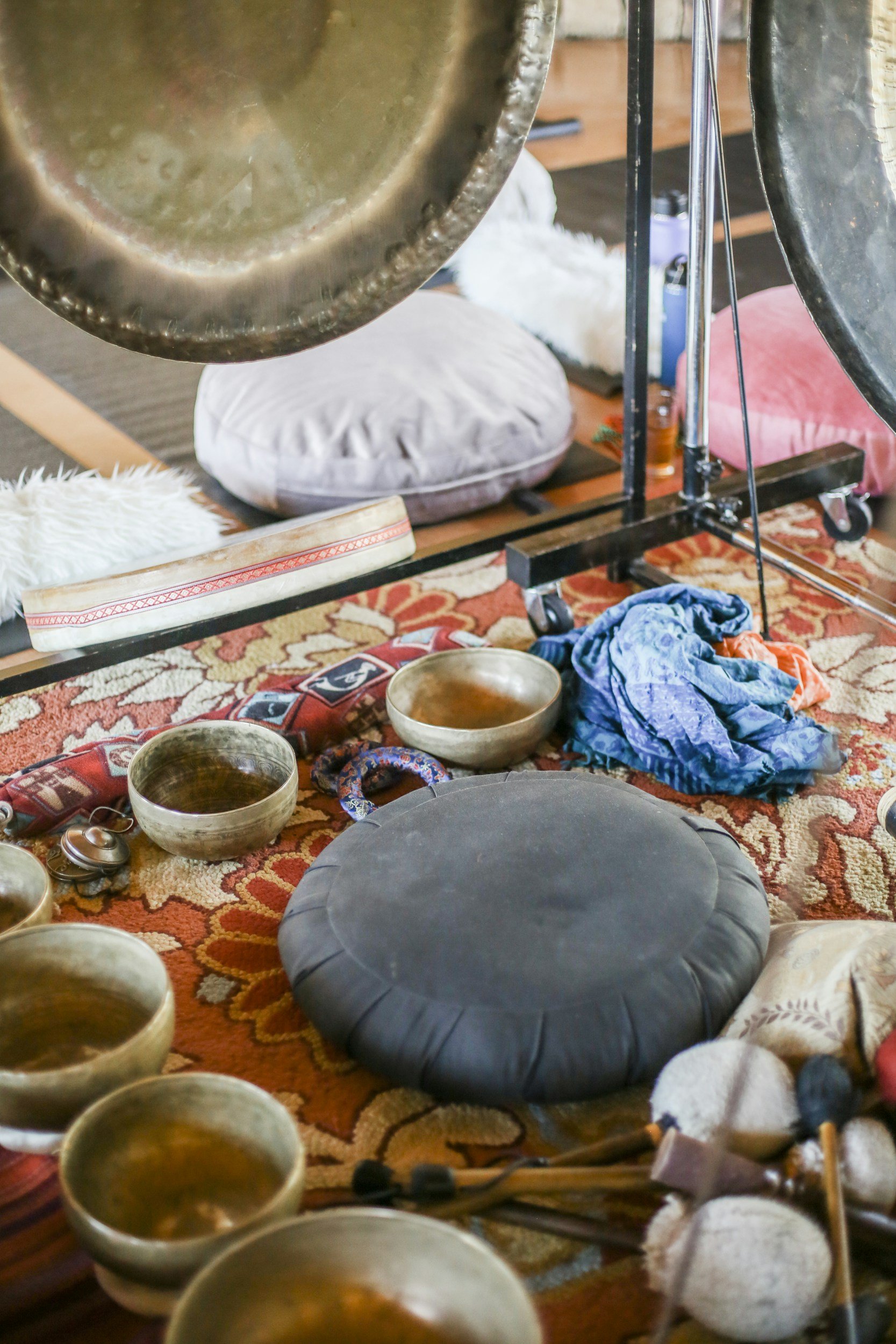
Sound healing sessions typically involve instruments such as crystal singing bowls, gongs, and other instruments. These tools produce vibrations that interact with the body and mind, helping to:
Calm the nervous system
Shift brainwave activity
Release stored emotions
Create a meditative or deeply relaxed state
Because the human body is made up of about 60% water, these vibrations may also influence our physical state on a cellular level, promoting flow and alignment in the body’s energy systems.
Potential Benefits
Clients often report a range of benefits from sound healing, including:
Reduced stress and anxiety
Improved sleep quality
Enhanced focus and mental clarity
Pain relief and muscle relaxation
Emotional release and trauma processing
Chakra balancing and improved energy flow
Frequently Asked Questions
-
A sound bath is a meditative experience where participants rest comfortably while listening to the soothing sounds and vibrations of instruments such as singing bowls, chimes, and other resonant instruments.
The sounds help create an environment that supports relaxation, mindfulness, and nervous system regulation. Many people experience a sense of calm, mental clarity, or deep rest during a session.
-
Participants typically lie down on a yoga mat or blanket while the sound bath facilitator plays a variety of instruments in a gentle, flowing sequence.
There is nothing you need to do during the experience. You can simply relax, breathe naturally, and allow the sounds to wash over you. Some people meditate, some drift into a restful state, and others simply enjoy the quiet time.
Each person's experience is unique.
-
For most sound baths, guests are encouraged to bring items that will help them feel comfortable while lying down for about an hour.
Common items include:
• A yoga mat or something soft to lie on
• A blanket for warmth
• A pillow or bolster for support
• An eye pillow or eye mask (optional) -
Absolutely. Private sound baths can be hosted for gatherings such as:
• Wellness events
• Celebrations or special occasions
• Friend or community gatherings
• Workplace wellness eventsIf you’re interested in hosting a private session, feel free to reach out to discuss availability and details.
-
Not at all. Sound baths are accessible for people with all levels of experience, including those who have never tried meditation before.
The sounds naturally support relaxation, so many people find it easier to settle into a calm state than with silent meditation.
-
What might I experience during a sound bath?
Experiences vary from person to person. Some common experiences include:
• Deep relaxation
• A quieting of the mind
• Sensations of vibration or warmth
• Emotional release
• Feeling refreshed afterwardThere is no “right” way to experience a sound bath — simply allowing yourself to rest is enough.
-
Sound baths are generally very gentle experiences. However, if you are pregnant, have sound sensitivities, use hearing devices, or have a medical condition that may be affected by sound, you are encouraged to reach out beforehand so we can discuss what will feel most comfortable for you.
-
Most sound bath sessions last 60 minutes, though if you are hoping to host a private event it can be customized.
Background on Sound HealingWhat the Science Says
1. Brainwave Entrainment
Rhythmic sounds—such as drumming or binaural beats—can help synchronize brainwaves to specific frequencies, a process called entrainment. This has been linked to:
Decreased anxiety and stress
Better sleep onset
Improved focus and meditative states
Example: A 2019 meta-analysis in Psychological Research found that binaural beats can positively affect mood and cognition.
2. Music Therapy
While not identical to sound healing, music therapy is a related and well-researched practice. Studies have shown that music can:
Reduce cortisol (the stress hormone)
Lower anxiety and heart rate
Aid in PTSD, depression, and pain management
Example: A 2013 study in The Lancet found that music therapy reduced preoperative anxiety more effectively than a sedative.
3. Vibroacoustic Therapy
This method uses low-frequency sound waves transmitted directly through the body to:
Reduce muscle tension
Improve motor function in conditions like Parkinson’s
Manage pain, including fibromyalgia
Example: Research published in Disability and Rehabilitation (2004) reported improved mobility and reduced pain after vibroacoustic treatment in Parkinson’s patients.
Sound, Water, and the Body
Studies in cymatics—the study of visible sound vibrations—have shown that sound can organize water molecules into intricate geometric patterns. Given the high water content of the human body, some practitioners believe sound vibrations may influence the body's energetic and cellular structures in similar ways.
Crystal singing bowls, in particular, are thought to resonate with the body’s energy centers (chakras), encouraging balance and healing. While direct scientific evidence is still emerging, the experiential and emotional benefits of sound healing are increasingly supported by both anecdotal and research-based findings.
References
Binaural Beats and Brainwave Entrainment
Garcia-Argibay, M., Santed, M. A., & Reales, J. M. (2019). Efficacy of binaural auditory beats in cognition, anxiety, and pain perception: A meta-analysis. Psychological Research, 83(2), 357–372. https://doi.org/10.1007/s00426-018-1066-8
Lane, J. D., Kasian, S. J., Owens, J. E., & Marsh, G. R. (1998). Binaural auditory beats affect long-term memory. Physiology & Behavior, 63(2), 249–252. https://doi.org/10.1016/s0031-9384(97)00436-8
Music Therapy
Bradt, J., & Dileo, C. (2013). Music interventions for mechanically ventilated patients. Cochrane Database of Systematic Reviews, 2013(12). https://doi.org/10.1002/14651858.CD006902.pub3
Vibroacoustic Therapy
McKinney, C. H., & Tschiesche, A. (2004). Vibroacoustic therapy: A review of the literature. Journal of Music Therapy, 41(1), 1–16. https://doi.org/10.1093/jmt/41.1.1
Sound, Water, and the Body
Chladni, E. F. (1787). Entdeckungen über die Theorie des Klanges. [Discoveries in the Theory of Sound]. https://doi.org/10.3931/e-rara-11718
Popp, F. A., & Nagl, W. (1984). Biophoton emission and its relation to cellular regulation processes. Experientia, 40(12), 1381–1385. https://doi.org/10.1007/bf01926871